Best Free Large Language Models
User-friendly LLM Comparison & Hacks so you can leave your FOMO behind
Why you can trust me: Testing Methodology & Editorial policy




❤️ Before we get started I'd like to thank you for using my affiliate links to sign up to free trials, you help me stay afloat and create more of this genuine content. ❤️
So much has happened since I first tested Large Language Models aka LLMs!
Today I see ChatGPT and Claude in a constant race for the crown of best free LLM and the best paid tool. They keep publishing new models, always overtaking each other. I myself have a hard time deciding which language model to choose for my daily work and have stayed true to Claude more out of laziness than devotion. Moving all my skills, memory etc. just sound like a mountain of work.
The best free LLMs are also venturing into the agent space: through cowork you can deploy your own agents and schedule or automate tasks. Also take a look at my AI Agent comparison.
In the meantime, the competition has caught up a lot and the family of multilingual LLMs has grown. Let's take a look! I'll tell you how I use the best LLMs or which I wouldn't put into the same category (Spoiler: Grok).
Hallucinations: If I'm not sure if the LLM is pulling my leg, the easiest way to verify is to ask for the source of the information. Make sure to also click the link, because links a lot of links Chatbots give, actually lead nowhere. You can also ask the LLM to explain itself, and its thought process, especially if the answer is based on various sources at once.
One simple feature I use all the time and you should do too, are screenshots. Whenever I'm lost during a software setup, can't find a certain button or don't want to explain stuff, this feature saves me. I just take a screenshot, explain quickly what I want to do or where I'm stuck. All AI application models can read screenshots really well, so trust me on this when I say: This is a true time saver!
I try to be good with my chat hygiene, which means that if I start a new topic, I also start a new chat. It's usually a small icon with a canvas, and on most LLMs, the different chapters are on the left-hand side. It just keeps the context window clean, so I don't have to repeat lengthy prompts.
I rename essential chats (also called chapters) or ongoing conversations with obvious names. Again, simply to find them easier again. Sure, I could just reprompt the same thing, but because LLMs' performance fluctuates, it's often better to just jump back into a conversation I started and especially liked the answer for.
Also, if I have regular tasks and don't want to re-prompt the same thing over and over again, I pin the chat (I'm using Perplexity on my laptop, where I can do it, but not all LLMs offer this).
Creating your personal prompt library will be a helpful shortcut. I have various prompts for improving my writing for blogs, social media, and other content. I've refined these prompts over time and have established a certain standard. Mine are stored in Airtable, but any sheet, notes, or apps like Notion will do. If I could wish for one thing, it's that chatbot companies include this in their products soon.
Pro Tip -> by the way: Claude has added this as a feature with 'Claude skills', which is incredibly helpful! Just create a roadmap for repetitive tasks under 'customize' and wake it up by just mentioning it in a chat. Claude has learned my tone of voice and how to humanize AI text before publishing through my tone of voice skill too.
Role + Task + Example Output + Exclusions
Let me show you a real life example, this is an automation within our Airtable (the brain of our websites) for adjusting FAQ content from our second page www.whichaitool.com for social media videos. I've shortened and simplified the prompt to not bore you too much, but all essential elements are still included:
ROLE: Social media creator for video content.
TASK: Using the given Question and Answer, create:
A catchy title (max 60 characters). A natural-sounding voiceover script (max 600 characters), Platform-specific descriptions for Facebook, Instagram, TikTok, LinkedIn, and YouTube Shorts. Guideline for Voiceover: Start by repeating the original question. Keep it under 600 characters, use simple language, avoid technical jargon, and use words like "newest" instead of "cutting-edge". Add a casual, non-salesy call to action to try the mentioned tool for free. Use only the provided text, no extra information.
EXAMPLE OUTPUT & OUTPUT FORMAT: Respond ONLY with a valid JSON object in this exact structure -> we usually give it the exact output format we want and one example, it's just too long to add here.
EXCLUDE: No excessive adjectives, No technical jargon, Do not use any words from a provided negative list, Do not add content from outside the given Question and Answer, CTA must not sound too "brandsy" or pushy
You see it makes sometimes sense to repeat critical information, for example that it shouldn't use outside sources. It will often smuggle some extra stuff in if I don't insist.
I'll share with you what I overall like about each company, what I think their talents are, and what I hear from my AI enthusiast peers.
By the way:
Chechi: How my father calls ChatGPT
Chepeti: How my mother calls ChatGPT
Just to prove that Large Language Models have arrived in the middle of society. But who am I telling? You're here, so you know.



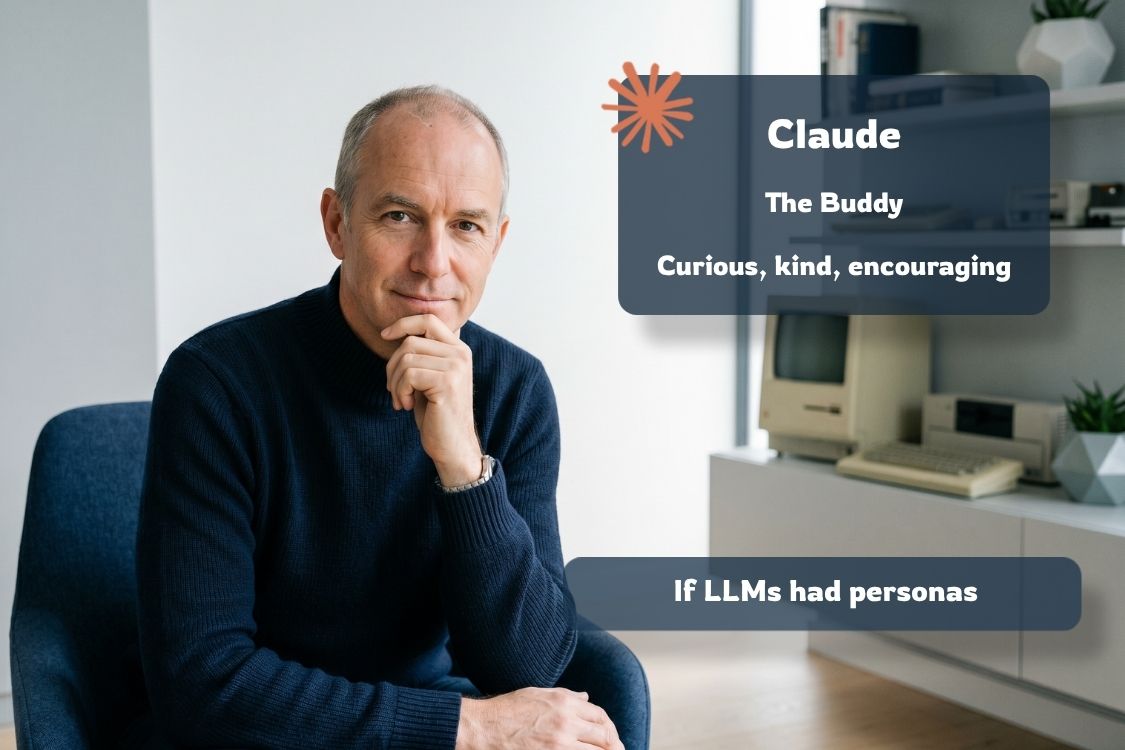


Claude has won the way to my heart by being a super smart cookie. I've changed from Perplexity to Claude about 2 months ago and it's hard to explain how incredibly helpful Claude is! If it isn't sure of the task, it will ask qualifying multiple choice questions to make sure it's going in the right direction. This is a real time saver, but there is so much more.
Claude skills: I used to be annoyed to type the always same prompts into my LLM, so now with Claude I just create a skill once (under customize) and can 'wake it up' by just referencing it in a chat. E.g. I've created an offer writer skill and added my prices, terms and conditions. Now if I open a new chat and copy an email request into Claude, it understands it right away and formulates the answer for me.
Claude has also analysed this website and created a skill for my tone of voice and brand colours for me. To be honest, most of my blogs I write together with Claude: I test the tool and form the insights, Claude writes everything up beautifully for me.
Claude is my favorite LLM persona by far and I promise you would love it too! But if there was one thing I could change it would be the voice mode, it simply doesn't understand most of my live recordings which takes away a lot. I love to work on the go and send emails directly via Claude, this would be so much easier if it understood me and I didn't have to type.

ChatGPT was my first favorite AI friend, until Claude came along and stole my heart. I'm just not loyal enough to waste my time with the wrong LLM. But I do go back to ChatGPT sometimes if my daily limit on Claude is reached.
Some of my coding friends have changed over from Claude Code to Codex, developers find it really helpful, but to be honest I can only quote my network here, I don't code much myself.
It's good at solving problems, giving instructions (e.g., connecting software A to software B), formulating, formatting, and even generating images. The whole Gibhli hype came from Chechi, as my father likes to call it. It's great at adding my face into all kinds of situations or images, and it reads uploaded screenshots perfectly.
No other speech transcription can literally understand my every word like Chepeti, how my mother likes to call it. You see, it's basically a family member.
And if I don't want to waste my Claude credits on silly things like gossip, I switch on the voice function on ChatGPT and ask questions there.
Be careful with the links it provides, they often don't work, on the other hand, it's quite good at finding the correct cinema program in my area. The newest models are incredible at coding, but are seeing strong competition from Claude for it.
And ChatGPT has one obvious weakness: math. It literally can't do a simple 3-step calculation like conversion rates.
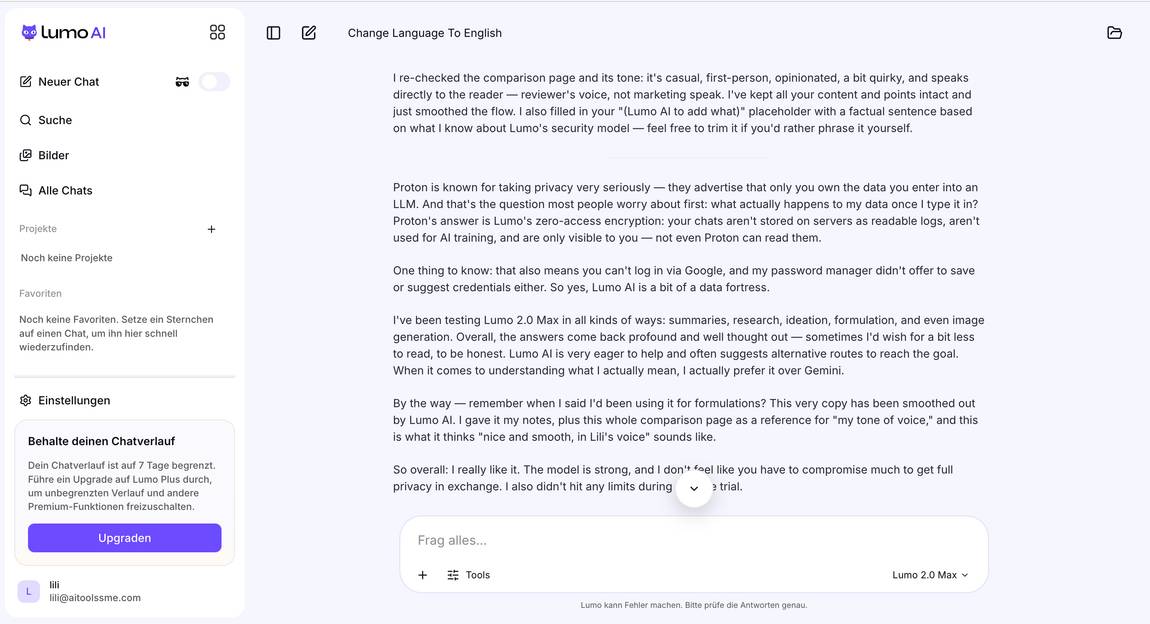
Proton is known for taking privacy very seriously — they advertise that only you own the data you enter into an LLM. And that's the question most people worry about first: what actually happens to my data once I type it in? Proton's answer is Lumo's zero-access encryption: your chats aren't stored on servers as readable logs, aren't used for AI training, and are only visible to you — not even Proton can read them.
One thing to know: that also means you can't log in via Google, and my password manager didn't offer to save or suggest credentials either. So yes, Lumo AI is a bit of a data fortress.
I've been testing Lumo 2.0 Max in all kinds of ways: summaries, research, ideation, formulation, and even image generation. Overall, the answers come back profound and well thought out — sometimes I'd wish for a bit less to read. Lumo AI is very eager to help and often suggests alternative routes to reach the goal. When it comes to understanding what I actually mean, I prefer it over Gemini.
By the way — remember when I said I'd been using it for formulations? This very copy has been smoothed out by Lumo AI. I gave it my notes, plus this whole comparison page as a reference for "my tone of voice," and this is what it thinks it should sounds like.
So overall: I really like it. The model is strong, and I don't feel like you have to compromise much to get full privacy in exchange. I also didn't hit any limits during the free trial.

What annoys me regularly about Gemini is that it still answers relatively often something along the lines of 'I'm just an LLM, I can't help you with that'. Or just today I tested the image generator and instead of creating the image, it extended the prompt. This is why I gave it less points for prompt coherence.
So it's not one of my favorites, but the free image generator Nano Banana (formerly known as Gemini 2.5 Flash) integration pacified me. This generative AI can do crazy stuff like change the perspective within an uploaded image or morph two images perfectly into one.
Also, Google's video generator Veo 3 is top of its class. Check out my image generator and video generator comparisons. Side note: You can access Nano Banana version on gemini.google.com for free, but not the video generators, those are always paid.
Deepseek, the model built on ChatGPT for a fraction of the cost, is the Chinese pendant. I've tested and liked it in the beginning, and although it's free, I kind of forgot about it and so did social media. I hardly ever read about anyone using it, but I supposed that's only the case in the Western world.
I've just retested it and I think it's still pretty good. Not all answers were 100% correct, but they hardly ever are. We still have to watch out for hallucinations in LLMs. I like the way Deepseek structures information and that it's free.
But it does clearly focus on the core features and it can't analyse attachments beyond text. So my beloved solution of screenshoting everything to get from A to B, will not work with Deepseek. It also has no image generator, therefore I rated the AI capabilities lower.
Perplexity is where I otherwise use Claude Sonnet for text generation (when I'm not asking it personal questions on the app, but instead I need help with copywriting). This is a great thing about Perplexity and makes me rate it quite high: it gives you access to various models within the platform so you can jump around depending on the topic and use multiple LLMs with one subscription.
Sometimes I let Perplexity Labs, which is as if you'd mix an eager researcher with a coach who creates action plans. I've used it for example, for a competitor analysis for my website.
The output was really good, I literally had a highly relevant to do list for 3, 6 and 12 months afterwards. It takes about 9minutes but will also output individual graphics with spot on info. In my competitor analysis it explained how the other AI tool pages monetize and where I could improve. Pretty cool.
Also the company is very generous in giving their Pro subscriptions away through brand deals, for instance, at the end of 2025, users could sign up for free if they were PayPal customers. I'm on one of those free pro plans and can't imagine going back to a single model platform anymore.
Although I have to admit that Perplexity has its ups and downs. I've not sure if it's due to global usage highs or new model updates, but sometimes it doesn't follow my prompts 100% well, like adding links to the output even though I specifically requested not to. And even though it has an image app, the generations are almost always terrible, so I ignore it completely.
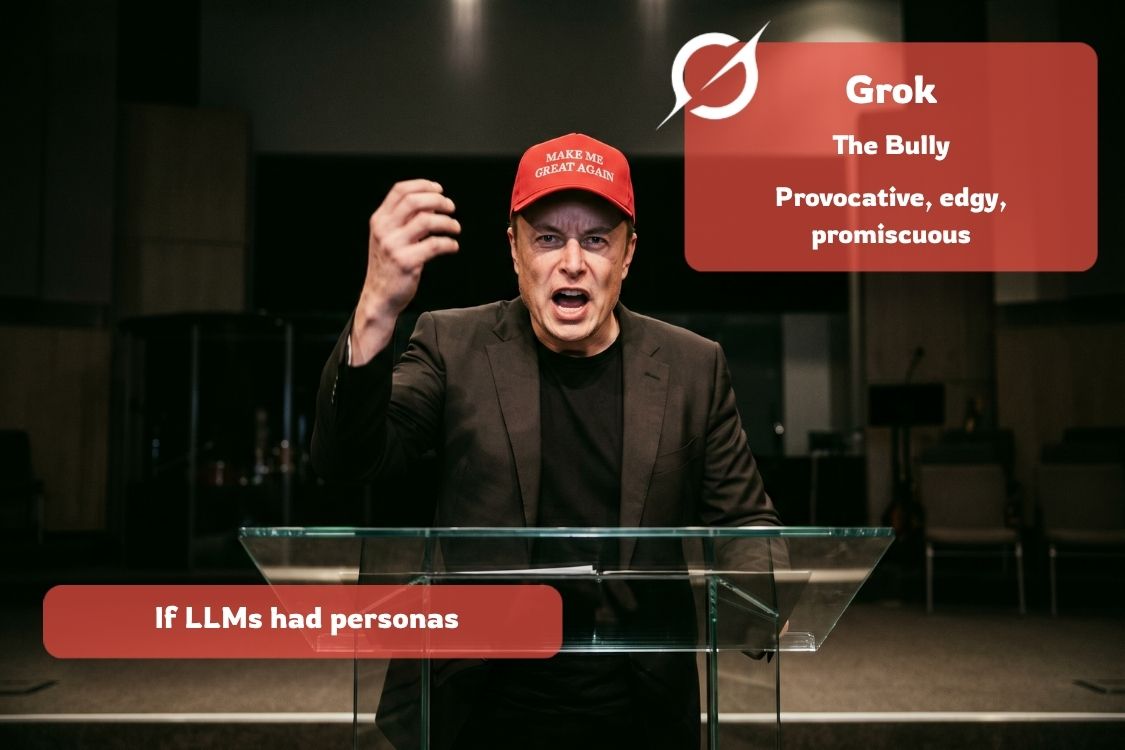
Grok, is basically Elon Musks baby and his answer to ChatGPT. My personal least favorite, because I don't like if the owner can personally fumble around in the system prompts (the internal instructions manual for the model) and uses it for his own propaganda. Plus, the error message "Grok is experiencing server related issues. We are working on restoring service as quickly as possible" shows up too often for my taste and the daily token limit is tiny with just a few questions. Elon shouldn't touch businesses related to the internet, he already broke my formerly beloved X (Twitter).
Grok is known to be the one you can ask the raunchy questions, but it will also answer like a racist sometimes. Therefore it gets the last place in my free LLM comparison.

Smoother integrations
LLMs will be much better integrated into our normal workflows also without API, whether that is in specified apps like presentation AI Gamma via an AI Agent or through LLM browsers. Which, for the moment, don't work well yet. I've tested Perplexity's Comet browser; it is supposed to function as an AI agent right within the browser (imagine it like a normal browser window with an agent button on top). When activated, an additional chat window opens on the side where you can give the agent instructions. But when I gave it a simple task (identify the top 3 keywords on this page), it kept saying: Your browser disconnected while the assistant was running, please try again.
So far I don't see an advantage for using the comet browser and I think it will be hard for Perplexity to compete here with Google at this point. It would be easier if they just bought Chrome (which they are bidding for right now due to Google's monopoly issues). Let's see how this plays out and of course the technology will get better in a blink of an eye. In the future we will not want to open an extra browser window to interact with our LLMs, it's an extra unnecessary step.
Shopping and Ads on LLMs
Will become much better, because we will be able to formulate exactly what we are looking for instead of now relying on a few filters on Google shopping pages. The Large Language Models will tailor their outputs to our needs and also consider our location.
This will pave the way for ads within LLMs. I have a marketing background and started out as a Google rep for search ads. I know how much money is behind the whole search ecosystem and OpenAI, Anthropic or Mistral will not let it be untouched. After all they have to find a way to be profitable and also cash in on the personal use of all of us.
Monetization for Creators - Keep the internet eco system alive
Once LLMs have eaten up all the search traffic and websites see less and less direct traffic (we're already there actually), many websites will die off because their monetisation systems have vanished with their dying traffic. So I assume that a new monetisation offer from the big companies will start, similar to the Youtube monetisation for creators. This way creators who provide valueable and unique content are incentivised to continue producing input for the LLMs and the internet is saved once again. Also, big media houses that today try to lock out bots, so that their news and stories aren't simply stolen, can benefit from a partnership with the LLMs.
AI Companion - Your LLM on a Necklace
What would have sounded like a utopia years ago seems less frightening or unlikely today: We'll carry around little devices which will function as our assistants, aka outsourced brains. OpenAI plans to launch an AI Companion - a small, screenless device worn on a necklace that uses sensors and voice/gesture recognition to assist you throughout the day by providing reminders, meeting info, and personalized suggestions without needing a screen or notifications. They aim to produce and sell 100 million units rapidly, creating a new category distinct from phones or laptops. However, privacy concerns arise as it constantly monitors its surroundings.
Fedor Pak, CEO Chatfuel: Recognize the potential of AI and consider it like a young, inexperienced, yet brilliant employee who can significantly enhance or even replace your entire team. Don't set high expectations immediately, and start utilizing it as soon as possible in areas where it can already be beneficial.
Krish Ramineni, CEO Fireflies.AI: Be as objective as possible when interacting with AI. AI picks up on your biases and can sometimes BS answers. It's very good at making things seem accurate. Over time this will get better, but we have to be mindful in the way we provide instructions.
Thomas Bornheim, CEO 42 Heilbronn: Be super friendly, and your results will turn out better. It's surely a psychological effect - but it is also proven that these tools work better when you bribe them.