Nano Banana Pro vs. Nano Banana 2
I tested the two models with the same prompt - Here's what model is better!



❤️ Before we get started I'd like to thank you for using my affiliate links to sign up to free trials, LLMs are constantly stealing my content and you help me stay afloat and create more of this genuine content ❤️
When I saw that Nano Banana 2 had just dropped, I was genuinely excited but also a little skeptical. Nano Banana Pro is still, in my opinion, the best image generator out there. And yes, since it launched in November 2025, quite a few strong contenders have entered the space, including GPT Image 1.5 from OpenAI, FLUX.2 from Black Forest Labs, and Seedream 4.0 from ByteDance. Each impressive in their own right. But none of them have been able to fully knock Nano Banana Pro off the top spot for me.
So here I am, testing Nano Banana 2 just one day after release, through Artlist where I do most of my image and video work. And while I'm excited, I'm also a bit doubtful. Can a new model really top what Nano Banana Pro was already doing?
According to Google, Nano Banana 2 (technically Gemini 3.1 Flash Image) is designed to bring the best of both worlds: the advanced quality and world knowledge of Nano Banana Pro, combined with the speed of Gemini Flash. That means faster edits, sharper outputs, more precise instruction following, and better character consistency across multiple images. It also promises improved text rendering and up to 4K resolution. Not bad on paper.
Let's see if it actually delivers, shall we?




And that's actually where the problem starts with Nano Banana 2 here. It takes that creative freedom and runs way too far with it. The output is over the top, adding all kinds of details I never asked for. Why are they suddenly on a spaceship? I didn't request that. Nano Banana Pro, on the other hand, does what the best artists do: it adds its own touch without losing the plot. It interprets the prompt without hijacking it.
What does stand out in a very positive way though, is the realism. The Nano Banana 2 image is razor sharp, almost like you could step right into the scene. That level of detail is genuinely impressive and shows how far the technology has come.
But sharpness alone doesn't win this round. Prompt coherence matters more to me, and Nano Banana Pro simply nailed the brief better.
Verdict: Nano Banana Pro takes Round 1.
Prompt: Create an image of 2 people looking at each other and shaking hands, one is a cyborg, the other a woman. The background is space and the mood is friendly.
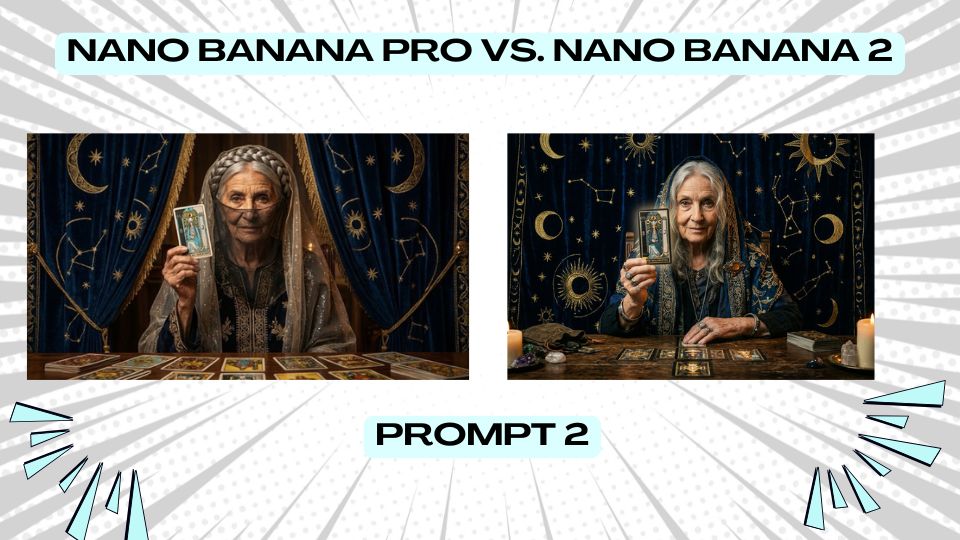
My first impression of the Nano Banana 2 output is that the woman looks extremely real, noticeably more so than the Pro version. And the details it chose to add are spot on: a pouch for the tarot reader, candles, crystals. Unlike Prompt 1, where the extra details felt like they were changing the story, here they're adding to it. They make the scene richer without pulling you out of it. That's a big difference and it shows that Nano Banana 2 isn't just throwing things at the wall. At least this time.
Beyond that, Nano Banana 2 handles everything else well too: the cards, the background, the overall atmosphere. It all comes together nicely.
The Pro version isn't bad by any means, but there's this slightly too-perfect hair piece that feels a little off. Nano Banana 2 gets the imperfections right, and in portrait work especially, that's what makes something feel truly believable.
Verdict: Nano Banana 2 wins Round 2. The new model's interpretation is more fitting, more detailed, and honestly just more alive.
Prompt: Create an image of an older lady with natural wrinkles and grey hair laying tarot cards. We see her from the front as she holds one card up. Her look is mysterious, she is wearing a veil and the background is a dark blue velvet curtain with golden stitchings of stars, the moon and star constellations. The style is somewhat between Dune (the movie) and Aladdin, with a shiny gloss on it.

So it feels a little petty to turn around and say Nano Banana 2 went overboard again, but here we are. It defaulted to a space station covered in chrome design elements, and while that's one valid interpretation, chrome elements could have been so many other things: a landscape, a vehicle, abstract structures. The choice feels predictable and a bit heavy handed.
That said, I don't hate it. And once again, the realism is striking. I'm actually starting to get ideas about better use cases for this level of detail and sharpness, because the output quality itself is genuinely impressive, just not well matched to this particular brief.
To be fair, Nano Banana Pro didn't nail it either. The result is somehow hazy, almost like a sandstorm is rolling in, which gives it this soft blurry quality that doesn't quite fit a chrome aesthetic. But the chrome elements themselves and the overall style feel more considered and more interesting to me.
Verdict: Nano Banana Pro wins Round 3, not because it was perfect, but because its chrome style felt more intentional and better matched the spirit of the prompt.
Prompt: Create a mars landscape with chrome design elements.
For this prompt I asked both tools to merge two images into one, and on top of that, to change my facial expression in the output. And I have to say, Nano Banana 2 delivered. I recognise myself clearly in the result, which sounds like a low bar until you realise I only gave it one input image to work with. I ran the same prompt about 10 times and every single time, it still looked like me. That's not nothing. That's actually really impressive.
The expression change worked well too, Nano Banana 2 picked that up and executed it naturally rather than giving me that slightly uncanny, over-processed look you often get with these kinds of edits.
So Google, consider that check mark on character consistency earned.
Verdict: Nano Banana 2 wins Round 4. Character consistency with a single input image, across 10 generations, is a genuinely strong result and exactly the kind of real world improvement that matters.
Prompt: Add me to the mars landscape image, I'm standing in the middle of the landscape, wearing a space suit without the head piece. I'm looking into the camera, looking excited.
Here's how I'd break it down: reach for Nano Banana 2 when you need speed, because it is noticeably faster than its predecessor, when you want that razor sharp, almost hyper-realistic output, or when you're working with character consistency across multiple generations. The image merging capability with just one input image is also something I hadn't fully appreciated until this test, and it opens up some genuinely useful creative possibilities.
But don't write off Nano Banana Pro just yet. When you want a little less of that intense realism, when you need a more controlled, artistic interpretation without the model going overboard, or when you simply prefer a softer, more painterly result, the Pro version still has a lot to offer. It's not the old model collecting dust. It's the reliable creative partner you already know.
I tested both models through Artlist, where I do the majority of my image and video work. If you're not on Artlist yet, it's worth a look, I'll leave a link below.
Overall Verdict: It's a tie at 2-2. Use Nano Banana 2 for speed, realism, and character consistency. Keep Nano Banana Pro close for when you want more artistic restraint and a less sharp, more considered output.
And I'm not done yet. There are more prompts, more models, and more tests coming. If you want to be the first to know when the next comparison drops, sign up for the newsletter below.