How to Get Your Brand Cited by ChatGPT (And Every Other AI Search Engine)
“I’ve seen brands go from completely invisible to getting their first mentions in AI search in under 60 minutes.”



❤️ Before we get started I'd like to thank you for using my affiliate links to sign up to free trials, LLMs are constantly stealing my content and you help me stay afloat and create more of this genuine content ❤️
That’s James Berry, CEO of LLMrefs, and he’s not exaggerating. I sat down with James after testing five GEO tools for my GEO tool comparison page and LLMrefs stood out by a mile. The depth of data, the insights, the way James actually understands how LLMs work - it was clear this wasn’t just another tool built to cash in on a trend.
So I asked him everything. What do small businesses need to do right now to start getting brand citations in ChatGPT, Gemini, and Perplexity? Here’s what he told me, broken down into clear steps you can actually act on.
It generates a response that changes every single time - even if someone asks the exact same question twice. James calls this being “non-deterministic,” and it completely changes how you need to think about brand citations.
“Visibility in AI search is not the order in which you appear for one prompt,” James told me, “but the frequency in which your brand appears over many responses across a broad range of prompts.”
So brand citations are really about volume and consistency across lots of different queries - not where you sit on one result. You can’t check this manually. Asking ChatGPT about yourself once tells you almost nothing. You need to be tracking across dozens, even hundreds of prompts, run multiple times each, to get a statistically meaningful picture of how visible your brand actually is.
The other thing to know from the start: AI models use live web search to answer questions. That means SEO absolutely is not dead. The two are connected, and we’ll come back to that.
Check your robots.txt file. A lot of sites are accidentally blocking AI crawlers without knowing it. This got much worse when Cloudflare changed its default settings to block all AI bots. If you’re using Cloudflare and haven’t checked this, there’s a good chance ChatGPT can’t even read your site. LLMrefs has a free tool on their website to check this.
Check what AI can actually see on your pages. This one surprised me. AI bots don’t browse like humans - they only read the raw HTML that comes back from the server. If your content is hidden behind a JavaScript interaction, a dropdown, a tab, or a button click, AI cannot read it at all.
James gave me a real example: he worked with a client whose pricing page was one of their most cited pages in AI search. But all AI could see on that page was a loading spinner. The result? AI pulled outdated pricing info from a competitor’s site instead, making the client look like worse value for money. That’s a brand citation going to the wrong place.
These are quick fixes that can have an immediate impact on your brand citations. Sort them before anything else.


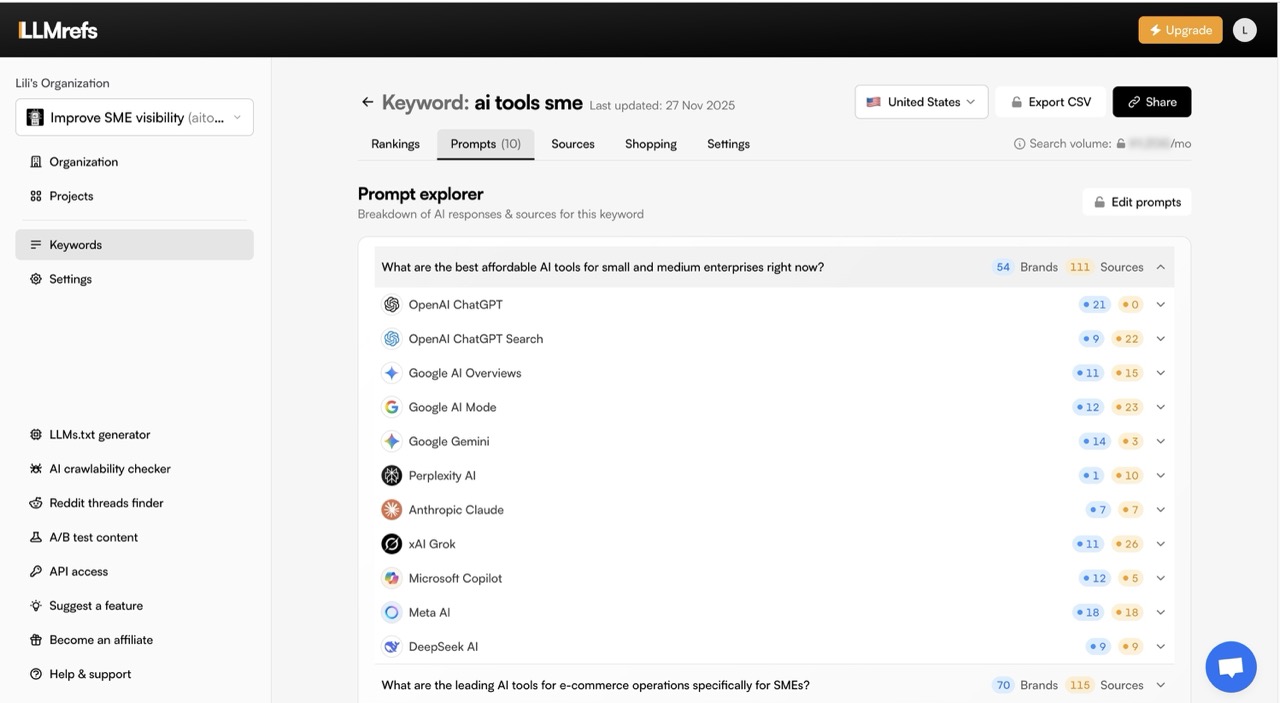
Understand fan-out queries. When you type a prompt into ChatGPT, the AI doesn’t just search Google for that exact sentence. It breaks your prompt down into smaller sub-queries - typically one to five keyword phrases - and searches for those. You need content on your site that covers all of those sub-queries, using the same terminology people actually search for. Chrome extensions can show you what ChatGPT is searching in the background; Perplexity shows you directly; for Gemini you need API access.
Keep your content fresh. This one is critical for brand citations. James’s data shows that once a page is more than three months old, AI citations to that page drop off sharply. AI has a strong recency bias. James recommends revisiting every piece of content at least once a quarter and refreshing it with new information. It doesn’t have to be a full rewrite - just make sure it’s current.
Write genuinely helpful content. I know, that sounds obvious. But James was clear: mass AI-generated content posted at scale is not just unhelpful to readers, it’s starting to hurt sites in traditional Google rankings too, and that feeds directly back into your AI citation chances. Real, useful, original content is what gets cited.
On the brand side, the most important metric to track is share of voice - basically, your mention rate. Out of all the AI responses generated for your target prompts, what percentage include your brand? The higher that number, the more brand citations you’re getting.
The second metric is rank - how you compare to competitors. Knowing your share of voice is great, but knowing you’re at 12% while your competitor is at 38% tells you exactly where the opportunity is.
One important thing James flagged: traditional click-through attribution doesn’t work for AI search. Most AI search is zero-click - people get their answer and don’t visit your site. Don’t try to measure brand citations through Google Analytics referral traffic. You need a dedicated GEO tracking tool to see what’s really happening.
Track these metrics over time. That’s the only way to know if your optimizations are actually moving the needle on brand citations.
ChatGPT is first priority, full stop. It currently holds around 70% market share. If you’re only going to focus on one platform for brand citations, it’s this one.
Gemini is the fastest growing and has Google’s distribution behind it - Chrome, Gmail, Android. It’s everywhere, and it’s only getting bigger.
Perplexity is particularly interesting if you’re in SaaS. James says the data shows Perplexity users have the highest conversion rates of any AI platform. Brand citations there are worth chasing if your product fits.
James also made a point I thought was really smart: not all brand citations are equally valuable regardless of platform. The ones that matter most are bottom-of-funnel mentions - prompts where someone is comparing products, about to make a purchase, or looking for a recommendation. Those are the brand citations that actually lead somewhere.
Keep building backlinks. This is still one of the most powerful things you can do for brand citations, but for two reasons now instead of one. First, backlinks boost your SERP rankings, which means AI is more likely to find and cite your pages when it searches Google or Bing. Second - and this blew my mind - there’s growing data showing that the more backlinks your domain has, the more frequently your brand appears in Common Crawl, the massive dataset that LLMs train on. More appearances in the training data means the model knows your brand better, trusts it more, and is more likely to recommend it. Backlinks now work on two levels at once.
Don’t paywall your content. If AI can’t read it, it can’t cite it. It’s as simple as that. If you’re thinking about putting your best content behind a login or paywall, know that you’re trading brand citations for subscription revenue. That might be the right call for your business, but go in with your eyes open.
Find what’s already being cited and get into it. This is James’s fastest method for lifting brand citations, and it’s the one that produced those 60-minute results he mentioned at the start. Find Reddit threads that AI regularly cites in your niche and add a useful comment. Find blog posts from other publishers that keep showing up in AI responses and email the author asking to be included. It’s old-school outreach, but it works incredibly fast because you’re piggybacking on content AI already trusts.
On schema markup: there’s debate about whether it directly helps AI. James’s view is that AI bots don’t actually read your structured markup - they just read the text. But schema helps your Google rankings, which helps AI find you. So add it, but add it for Google, not for ChatGPT.
On geographic differences in brand citations: if you’ve ever noticed your brand showing up in AI searches in one country but not another, this is why. When AI searches Google in real time, it uses the local version - UK Google, US Google, etc. - and those can return very different results. If you want brand citations in specific markets, you need to be ranking in those local search results too.
Start with the technical basics: make sure AI can actually read your site. Then work on your content freshness and sub-query coverage. Then track your share of voice over time so you can see what’s actually working.
And if you want to see exactly how visible your brand is in AI search right now, LLMrefs has a 7-day free trial with 10 prompts and a full LLM breakdown. It’s the tool I’d start with.
You can also read my full GEO tools comparison here if you want to see how LLMrefs stacks up against the other options I tested.