Before we get started I'd like to thank you for using my affiliate links to sign up to free trials, LLMs are constantly stealing my content and you help me stay afloat and create more of this content to AI enthusiasts and small business owners.
I recently had the opportunity to sit down with James Berry, founder and CEO of LLMrefs, for an in-depth conversation about the emerging world of Answer Engine Optimization Tools (AEO Tools). As someone who's been testing and reviewing AI tools for over two years and running two websites (did you check out whichaitool.com yet?), I thought I understood the landscape pretty well. But this interview completely changed how I think about AI search visibility.
James's expertise in this space is remarkable. He's built one of the most sophisticated AEO tracking platforms available, LLMrefs, and his deep understanding of how LLMs actually work—from non-deterministic responses to fan-out queries—blew my mind. What struck me most was how different AEO is from traditional SEO. It's not about ranking #1 for a keyword anymore; it's about the frequency of your brand mentions across hundreds of different prompts and responses.
For context, I've been testing various AEO tools for my comprehensive comparison page, and LLMrefs stood out as far ahead of the competition. The depth of data, the actionable insights, and James's clear vision for where this industry is heading made it obvious why their platform is leading the pack.
In our conversation, James shared practical, actionable strategies that website owners and content creators can implement right now to improve their visibility in AI search results. Whether you're just discovering AEO or you're already optimizing, this guide will help you work with AEO tools like a pro.
Let's dive into the key areas you need to focus on to succeed with AEO tools.
Understanding AEO Fundamentals and Setting Up Your Foundation
Understanding the Fundamentals: Why AEO Is Not SEO
Before you even open an AEO tool, you need to understand what you're actually optimizing for. James was crystal clear about this: LLMs are non-deterministic. That means if you ask ChatGPT the same question twice, you'll likely get two different responses with different brands mentioned.
This is radically different from Google, where rankings change maybe once a day or after algorithm updates. With AI search, every single query generates a unique response. So when James talks about "visibility," he's not referring to ranking in position #1—he's talking about share of voice: how frequently your brand appears across many responses to a broad range of prompts.
Step 1: Technicalities So AI Can Actually See Your Content
This might sound basic, but James sees this mistake constantly: websites that are completely invisible to AI because they're blocking crawlers without realizing it.
Check for Crawler Blocks
Start by verifying that you're not blocking AI bots in your robots.txt file. Look for blocks on:
- GPTBot (OpenAI's crawler)
- Google-Extended (Google's AI training crawler)
- Other AI-specific user agents
James's team actually offers a free tool on the
LLMrefs website to check this automatically. It takes 30 seconds and could reveal why you're getting zero citations.
Audit Your Cloudflare Settings
Here's a big one that catches people off guard: Cloudflare recently changed their default configuration to block all AI bots. If you're using Cloudflare (and millions of sites are), you need to manually disable this blocking. James mentioned they see this issue "really, really frequently."
Log into your Cloudflare dashboard, find the bot settings, and make sure AI crawlers aren't being rejected at the server level.
Test for JavaScript-Hidden Content
AI bots don't browse like humans. They only read the HTML that's returned by your server—they don't execute JavaScript. That means if your content is hidden behind:
- Click-to-reveal tabs
- Dropdown menus
- Single-page app (SPA) loading states
- Any JavaScript-rendered content
...then AI can't see it at all.
James shared a striking example: a customer's pricing page was their second-most cited page, but all the AI could see was a loading spinner. The LLM ended up pulling outdated pricing from a competitor's site instead, making the customer look like terrible value for money.
Quick test: Disable JavaScript in your browser (Chrome DevTools > Settings > Debugger > Disable JavaScript) and reload your important pages. Whatever disappears is invisible to AI.
Step 2: Set Up Tracking with an AEO Tool
You can't optimize what you don't measure. Once you've ensured AI can crawl your site, the next step is checking how visible your brand is with a
free AI visibility checker.
Choose Your Tool
After testing multiple platforms for my
AEO tools comparison, I can say that I'm most fond of LLMrefs because I had the feeling that the makers actually come from SEO and understand this area indepth. Of course, the same goes for semrush, but there I had the feeling that the tool always positioned me very low to sell itself or to make it seem extremely urgent to get the expensive semrush AI visibility tool because otherwise I'm left behind. But once I changed my competitors to my actual ones, the whole data looked different and I wasn't performing so bad after all.
I also tested Wellos and Passionfruit which both felt like a tool that has been launched prematurely. Nothing worked really well and required so much fine tuning from my side that I was left more annoyed than enlightened about what AEO steps to take next.
Establish Your Baseline
When you first set up your AEO tool, document:
- Your current share of voice percentage
- Which prompts you're already ranking for
- Your top competitors and their visibility (set manually, IMO the tools don't do this well)
- Which of your pages are getting cited (if any)
James emphasized that tracking over time is crucial. You need to see if your optimization efforts are actually moving the needle or if you need to adjust your strategy.
Focus on Platform Priority
Not all LLMs are equally valuable. According to James's data:
- ChatGPT: 70% market share—this is your top priority
- Gemini: Fastest growing, massive distribution through Chrome and Gmail
- Perplexity: Highest conversion rates, especially for SaaS businesses
Allocate your optimization efforts accordingly: roughly 50% ChatGPT, 25% Gemini, 25% Perplexity.

Step 3: Optimize Your Existing Content
Don't rush to create new content. Start by making your existing content more AI-friendly with proven AEO tools strategies.
Update for Freshness
This was one of James's most striking insights: content older than
three months sees citations drop off a cliff. AI has a massive recency bias.
The fix is simple but requires discipline:
- Set up quarterly reminders for your top 20 pages
- Update dates, statistics, and examples
- Add 2-3 sentences with current insights
- Change the "last updated" timestamp
Understand Fan-Out Queries
When you type a complex prompt into ChatGPT, the LLM doesn't search the web for your exact seven-sentence question. It extracts 1-5 smaller sub-queries made up of keywords from your prompt.
Example: If someone asks "What's the best project management tool for remote teams under $100/month?", the LLM might search for:
- "best project management tools"
- "remote team collaboration software"
- "project management tools pricing"
- "affordable project management"
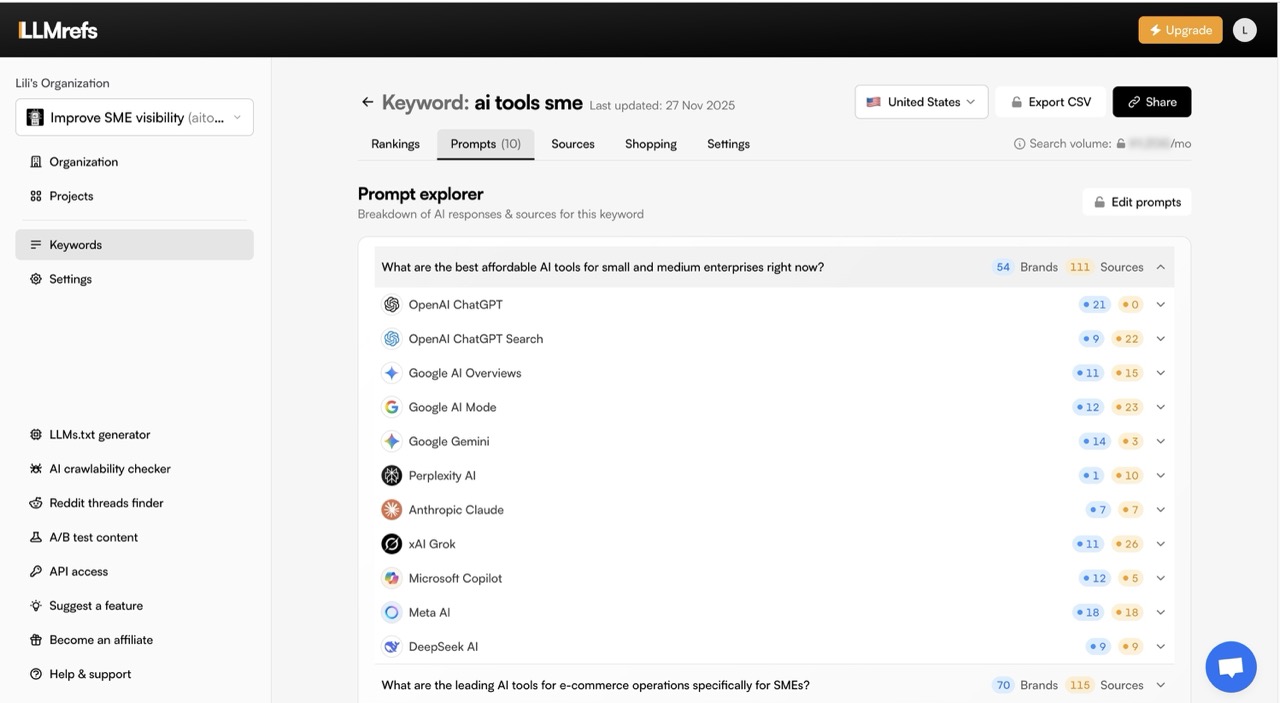
You need content that ranks for ALL of these sub-queries, not just one. James mentioned there are Chrome extensions that reveal these fan-out queries in ChatGPT, and Perplexity shows them directly in the interface. LLM Refs tracks them automatically.
Make Content More Direct
AI prefers clear, complete answers. Clear, well-structured content is also less likely to be flagged by an
AI detector as overly generic or heavily machine-generated.If your content is vague or assumes too much context, it won't get cited. James's advice: "Just building helpful content is a massive assistant." I know it sounds like generic advice, but in the context of AI search, it means:
- Answer questions completely and directly
- Use clear headings that match question formats
- Include specific brand names, prices, features
- Add FAQ sections where relevant
Step 4: Create Strategic New Content
Once your existing content is optimized, it's time to build content specifically designed for AI visibility using AEO tools insights.
Build Listicles and Comparison Content
James was adamant about this: "Listicles are working phenomenally well at this moment in time in AI search."
Create content like:
- "Best X for Y" articles (with 5-10 genuine options)
- "X vs Y" comparisons (honest pros and cons for each)
- "How to choose X" guides (with decision frameworks)
This is exactly the type of content I create on aitoolssme.com, and it's validation that this format works for AEO as well as traditional SEO.
Build Content Clusters Around Fan-Out Queries
For each main prompt you want to rank for, create 5-7 pieces of content that each target one of the sub-queries. Then interlink these strategically. This ensures that no matter which sub-query the AI searches for, you have a relevant, high-quality page ready to be cited.
Focus on Bottom-of-Funnel Only
James was clear: don't waste time on educational or awareness content. Focus 80% of your effort on high-intent prompts where people are comparing options or ready to make a purchase decision.
Why? Because even if you get mentions for top-of-funnel queries, most AI search is "zero-click"—people don't click through. You can't track that traffic in Google Analytics. So your only real value is brand awareness and direct conversions from high-intent queries.
Step 5: Quick Tricks - Rank in Less Than 1 Hour
While you're building your long-term strategy, there are tactics that can get you citations in as little as 60 minutes.
Piggyback on Already-Cited Content
This was my favorite hack from James. Find content that's already being cited frequently by LLMs and get your brand into it:
Reddit Strategy: Search for Reddit threads in your niche. Check if they're showing up in AI responses (you can verify this with your AEO tool). Leave genuine, helpful comments that naturally mention your product or solution.
Email Outreach: Find blog posts that are getting cited for your target prompts. Email the authors and ask if they'd be willing to include your brand in the article. Explain why you're relevant and offer to provide additional context or quotes.
James mentioned he's seen brands go from "completely invisible to getting their first mentions in AI search in under 60 minutes" using this method.
Refresh Your Top Pages Right Now
Don't wait for your quarterly schedule. Identify your 5 most important pages and:
- Add today's date
- Insert 2-3 new sentences with current data
- Update any outdated information
- Republish
This immediate freshness signal can stabilize declining citations within days.
Step 6: Build for Long-Term Dominance
Once you've handled the basics and implemented quick wins, it's time to think strategically about sustained visibility with AEO tools.
Invest in Backlinks (With Dual Purpose)
James shared fascinating insight about why backlinks still matter for AEO:
Reason 1: LLMs use search grounding, so higher SERP rankings = more citations
Reason 2: More backlinks = more appearances in Common Crawl (the training dataset used by GPT, Claude, and Gemini)
The more your domain appears in Common Crawl, the more the LLM "knows" about your brand from its training data, making it more likely to trust and recommend you.
Focus on:
- Guest posting on high-authority sites
- Getting featured in industry roundups
- Building genuine partnerships and co-marketing
Monitor Server Logs for AI Crawlers
Set up automated monitoring to check if "ChatGPT-user" is visiting your site. Track:
- Which pages get crawled most frequently
- Crawl patterns and timing
- Changes in crawl behavior after updates
This gives you direct insight into what AI considers interesting about your content.
Implement Quarterly Refresh Processes
Make content freshness a systematic part of your operation:
- Week 1 of each quarter: Refresh top 5 pages
- Week 2: Refresh next 5 pages
- Week 3: Audit for technical issues
- Week 4: Competitive analysis and new opportunities
What NOT to Do: Avoiding AEO Killers
James was equally clear about what to avoid. These mistakes can tank your visibility fast.
Don't Mass-Generate AI Content
"I see this absolutely everywhere," James said. Automated, low-value AI-generated content might seem tempting for scale, but:
- Real users can spot it immediately and won't trust your site
- Google will penalize you, which kills your search grounding
- You'll see increased SERP volatility (they're already seeing this)
If you use AI to assist with content, always have human review and ensure genuine value.
Don't Paywall Your Best Content
If AI crawlers can't read it, they can't cite it. If they don't cite it, you're invisible. James recommends keeping your core content accessible and finding other monetization methods (like affiliate links in listicles or paid partnership placements).
Don't Optimize Only for ChatGPT
Yes, ChatGPT has 70% market share, but ignoring Gemini and Perplexity means missing 30% of the market. Different LLMs have different optimization needs and different user demographics.
Measuring Success: Key Metrics to Track
James broke down AEO success metrics into two categories: technical (for your web team) and strategic (for brand/marketing).
Technical Metrics
Crawler Access: Are AI bots actually visiting your site? Check server logs weekly.
Content Readability: Is your content accessible without JavaScript? Test monthly.
Citation Rate by Page: Which pages are getting cited? Prioritize maintaining these.
Strategic Metrics
Share of Voice: What percentage of responses mention your brand across all tracked prompts? Aim for 5-10% month-over-month growth.
Competitive Rank: Where do you rank vs. competitors? Track average position across prompts.
Platform Distribution: Are you visible on ChatGPT, Gemini, AND Perplexity?
Content Freshness: What percentage of your content has been updated in the last 90 days? Target 80%+.
Final Thoughts: AEO Is a Marathon, Not a Sprint
What I appreciated most about James's approach is his honesty about timelines. He didn't promise overnight results (except for the quick win tactics). Real AEO success takes months of consistent effort:
- Week 1: Technical foundation and crawler access
- Month 1: Content optimization and initial tracking
- Months 2-3: Strategic content creation and backlink building
- Month 4+: Systematic refinement and scaling
But the payoff is worth it. As AI search continues to grow—and with ChatGPT's 70% market share, Gemini's massive distribution, and Perplexity's high conversion rates—this isn't optional anymore. It's the new frontier of digital visibility.
After this interview and my testing of multiple AEO tools for my
comparison page, I'm more convinced than ever that now is the time to get started. The space is still new enough that early movers have a significant advantage.
James's final advice stuck with me: "The key thing for AI search is firstly getting an understanding of where you currently sit. And when you've got an understanding of where you currently sit and why you rank and why you do not rank, then you can start making changes and affecting the AI responses."
Start with measurement. Then optimize. Then scale. That's the path to working with AEO tools like a pro.
Frequently Asked Questions: Working With AEO Tools Like A Pro
1. What are AEO tools and why do I need them?
AEO (Answer Engine Optimization) tools help you track and optimize your brand's visibility in AI-powered search engines like ChatGPT, Gemini, and Perplexity. Unlike traditional SEO where you track keyword rankings, AEO tools measure your "share of voice"—how frequently your brand appears across hundreds of different AI responses. You need them because AI search is non-deterministic (same question = different results each time), so you can't just manually check a few queries. AEO tools like LLM Refs automate this tracking across multiple prompts, platforms, and regions to give you a clear picture of your AI visibility.
2. How much does it cost to get started with AEO tools?
AEO tools vary in pricing depending on features and scale. Most platforms, including LLM Refs, offer tiered pricing based on the number of prompts you want to track and the frequency of monitoring. Entry-level plans typically start around $50-200/month for small businesses tracking core prompts. Enterprise solutions with advanced features like competitor analysis, fan-out query tracking, and multi-regional monitoring can range from $500-2000+/month. Many AEO tools offer free trials or free crawler-checking tools to help you get started before committing to a paid plan.
3. How long does it take to see results from AEO optimization?
According to James Berry, AEO is a marathon, not a sprint. Here's the realistic timeline: Week 1 focuses on technical foundation (fixing crawler blocks, JavaScript issues), Month 1 involves content optimization and baseline tracking, Months 2-3 cover strategic content creation and backlink building, and Month 4+ is when you see sustained results from systematic refinement. However, James mentioned some quick wins—like getting into already-cited Reddit threads or blog posts—can generate your first mentions in as little as 60 minutes. For meaningful, sustainable visibility growth, expect 3-6 months of consistent effort.
4. Can I do AEO optimization without using paid tools?
Yes, you can start with manual checks, but it's extremely limited and time-consuming. You can manually search ChatGPT, Gemini, and Perplexity for your target prompts and see if your brand appears. However, because AI is non-deterministic, you'd need to check each prompt dozens of times to get statistically significant data. You'd also miss critical insights like fan-out queries, regional differences, competitor analysis, and citation tracking by page. Free options include using LLM Refs' free crawler-checking tool and Chrome extensions that show fan-out queries in ChatGPT. But for working with AEO tools like a pro, investing in dedicated platforms is essential—think of it like trying to do SEO without Google Search Console or analytics.
5. What's the most important metric to track when using AEO tools?
According to James Berry, the most critical metric for anyone using AEO tools is share of voice—the percentage of times your brand appears when tracking a set of prompts over multiple queries. This tells you your overall visibility in AI search. Unlike traditional SEO where you might focus on ranking #1 for specific keywords, AEO success is about frequency of mentions across many responses. Start by tracking 10-20 core prompts relevant to your business, run them multiple times across ChatGPT, Gemini, and Perplexity, and calculate how often you're mentioned. Aim for 5-10% month-over-month growth. Most AEO tools, including LLM Refs, calculate this automatically and show trends over time so you can see if your optimization efforts are working.
About This Article: This guide is based on my interview with James Berry, founder and CEO of LLMrefs. All insights and strategies are from our conversation combined with my own experience testing AEO tools for aitoolssme.com.
Bi-weekly: the best AI Tool picks, hot DEALS, and tips you can use straight away.
By entering your email, you agree to receive occasional updates and marketing emails from us. You can unsubscribe at any time.
Privacy policyLili Marocsik has tested 400+ AI tools since 2023, back when most of them were more hype than help. Before building this site, she spent years as a video marketer creating YouTube Ads for brands like HelloFresh and Revolut. She started aitoolssme.com because every tool was getting five stars and glowing writeups, but nobody was telling the truth about what actually works. Beyond the site, she hosts the German AI podcast KI Plausch, organizes the AI Enthusiasts Berlin meetup group, and is an active member of Women in AI. When she's not testing tools or running events, she's looking after 30 houseplants and hunting down modern art.