Best Tools to Get Cited by AI Search Engines in 2026
Literally Hit or Miss...We'll give you the shortcut!
Why you can trust me: Testing Methodology & Editorial policy




❤️ Before we get started I'd like to thank you for using my affiliate links to sign up to free trials, LLMs are constantly stealing my content and you help me stay afloat and create more of this genuine content.❤️
AI search optimization tools start by analyzing your website or content topic to identify relevant queries that LLMs are processing. They show you where you're already being cited and highlight opportunities you're missing. Most tools also let you compare your visibility against competitors.
Some tools, like LLMrefs, go further with features like A/B testers that show which meta descriptions or titles LLMs actually prefer.
I generally recommend action-oriented tools over data-heavy ones. It's easy to get lost in endless metrics and fall into analysis paralysis when you're staring at millions of opportunities. The better tools give you concrete outputs: the best keywords to target, topics to cover, and placements like Reddit where LLMs are most likely to cite your content.
Connect your Google Search Console and Google Analytics accounts so these tools can automatically pull in relevant data alongside LLM insights.
Segmentation by country, not language: This really surprised me. Cited pages are grouped differently per country, even when those countries share the same language. My image generator page answers 99 US prompts but only 15 British and 14 Australian ones. I'm still working out why.
Feeling lost at the start: This is a new space and I often found myself unsure how to interpret the data. Most platforms need to do better at explaining what their metrics actually mean.
FAQs vs. regular content: My second site, whichaitool.com, targets LLM searches by answering questions only in FAQs. Despite having a low authority score, it consistently gets double the AI visibility of my main site. Worth thinking about.
Keywords vs. sentiment: I think exact keyword placement is going to matter less for AI search optimization as LLMs get better at judging relevance themselves. You still need to make your topic clear throughout your content, but I'm already shifting my focus toward unique, useful content over keyword placement.
1. Make sure AI bots can actually crawl your site Check your robots.txt file and confirm you're not blocking GPTBot or Google-Extended. Cloudflare's default settings now block AI bots, so disable that immediately. Use LLMrefs' free tool or check your server logs for the "ChatGPT-user" agent to verify access.
2. Get rid of JavaScript-hidden content AI bots don't execute JavaScript. They only read the HTML your server returns. Avoid single-page apps, click-to-reveal tabs, dropdowns, or spinners on important content. A quick test: disable JavaScript in your browser and see what disappears. That's what LLMs can't see either.
3. Update your content every 90 days AI has a strong recency bias. Content older than three months sees citation rates drop significantly. Set quarterly reminders to refresh your top pages with new stats, insights, and an updated timestamp. Keeping that "last updated" date current is one of the biggest factors for sustained AI search visibility.
4. Optimize for fan-out queries When an AI searches, it doesn't use your full prompt. It breaks it down into 1 to 5 smaller sub-queries. Create content that covers all of those sub-queries, not just the main topic. Use tools like LLMrefs to find them and make sure your wording matches each phrase.
5. Build backlinks for two reasons, not one Backlinks help with traditional SEO rankings, which increases your chances of being cited through search grounding. But they also increase how often your brand appears in Common Crawl, the training dataset used by GPT, Claude, and Gemini. More appearances in training data means LLMs are more likely to trust and recommend you.
Quick win: Find content that's already getting cited frequently, like Reddit threads or popular blog posts, and get your brand mentioned in it. You can generate your first AI citations in under 60 minutes this way.



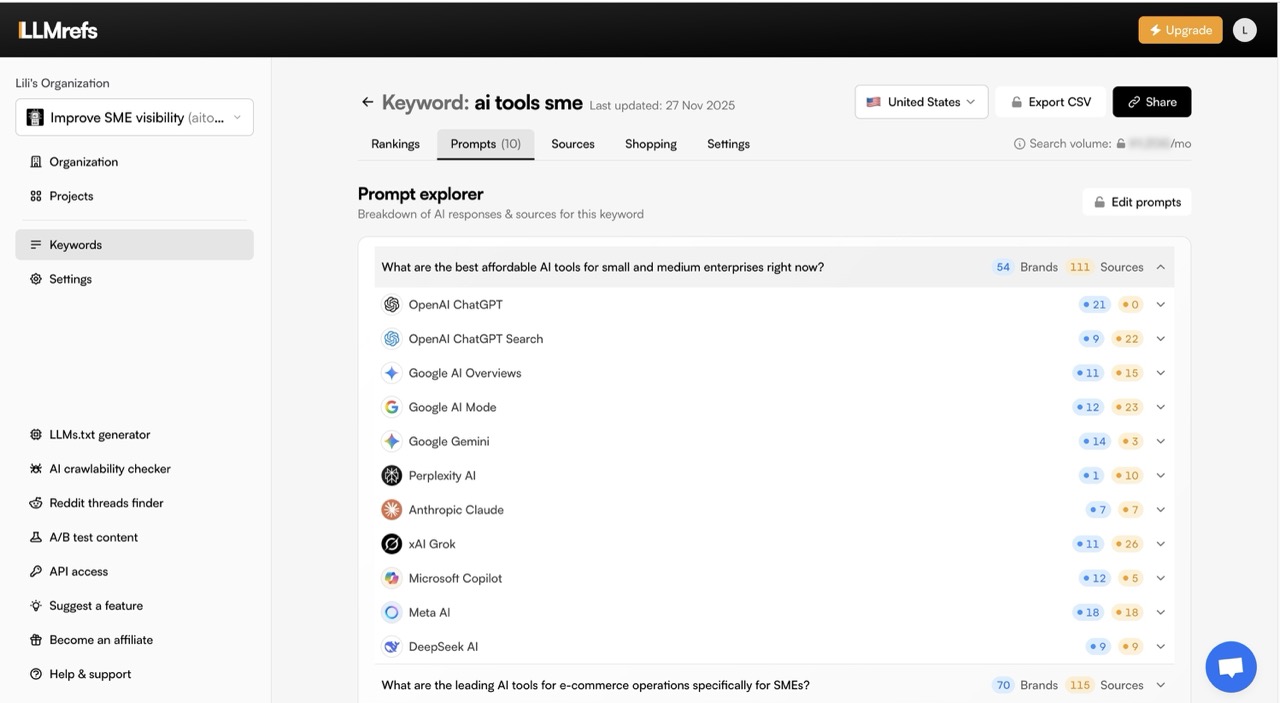


I really like LLMrefs; it's one of the more intuitive tools I've tested. It's super easy to work with, and the free plan is generous because it already gives you real features to start working with, even if you don't sign up.
Their ChatGPT-powered split testing tool is fantastic - it reveals which meta description or website copy AI search engines actually prefer, which takes a lot of the guesswork out of optimization.
And I love the prompt explorer feature where the geo tool shows you the most common prompts users would request from an LLM in your area. This gives you incredible insight into what people in your region are actually asking AI for.
LLMrefs includes a Reddit thread finder, which makes it even clearer that Reddit will soon be infiltrated even more than it is now by brands looking to leverage these insights.
The AI crawl checker is really useful too. It checks if all your settings are properly configured so that bots can reference your page. Before the era of LLMs, bots crawling your page wasn't necessarily a good thing. Today, ironically, we want them to "steal" our content.
What I really like about LLMrefs is that it gives you such a good roadmap and action points on what to improve. Especially compared to the more data-focused platforms like Semrush, this is actually helpful to get stuff done rather than just overwhelming you with numbers.


Adobe LLM Optimizer seems to focus more on brands wanting to monitor their websites, mostly due to their features and because they offer you a demo right away, but don't let you test the tool on your own data. That smells like a company targeting enterprises to me.
In their key performance metrics, they show visibility score, brand mentions, citations, authentic interactions and total referral traffic from LLMs, all metrics are super high level and relevant, exactly the amount of data I need.
The sentiment distribution breakdown is also really relevant, especially for brands. Since the trial account runs on dummy data, I can't determine how useful the competitor analysis actually is.
I didn't quite understand why they put so much emphasis on the Simplify Complex Content feature, since we're optimizing for bots and not humans and that shouldn't be so crucial. Also, in the dashboard it displays a button that asks if they should implement the changes right away and I couldn't figure out if the Adobe LLM Optimizer is supposed to connect straight to your website's backend.
But overall this seems like a well thought-out tool, which is a bit caught in the typical Adobe complex ecosystem. For example, just letting you test their tool on your own data seems like a hurdle they can't overcome and I can only guess that's connected to them being a huge corporation.

Promptwatch is better for brands, because the main features are brand visibility, Top Cited Domains or Organic Brand Mentions. Whatever I tried, I could always just see my brand, queries were connected to AItoolssme (not helpful) and citations too. Of course I'm looking for keywords like AI tools List etc. instead. But for brands I do see the value and I think it's a good tool, although I felt a bit lost getting started with it.
Also, Promptwatch has some super helpful features, e.g., Track AI search traffic to find out how big the LLM search volume of my topic is.
I like the "AI Search Performance" feature which tells me how many of the visitors arrived at my page through LLMs. You just have to past a code in the header of your website.
Promptwatch categorized me as a B2B company, which is funny, because in the end it is, I just never looked at it this way.
Another tool to offer a special discount when canceling the trial plan, 30% for 3 months ;)

For Peec AI you start with adding your website and a few more markers like language and location. You can also add topics and competitor brands, and Peec AI will research the prompts for these topics.
I feel like Peec AI is overkill for small businesses. It's a serious SEO tool with lots of options, and it's easy to get lost in it. Most of the time I wasn't sure what to do with the data or how to read it.
I would have wished for more hands-on advice and an action plan. I think Peec AI is more for agencies and people who work with this every day.
Also, according to the tool I have no AI visibility for the topic "AI tools" in LLMs, but other tools do detect it. A more helpful dashboard similar to the Adobe LLM Optimizer would help to get a good overview. Here I feel like there are too many dead ends.

Before we dive in, I should mention that I'm testing HubSpot AEO on the day of release, when the team hasn't yet received larger sets of customer data to fine-tune the tool with.
It started by asking about variations of my brand name, which I haven't seen anywhere else, and whether I'm a B2B or B2C business. It then presented the competitors it found for me, which were surprisingly relevant. It analysed my products and correctly identified them as tool recommendations and comparisons, and pegged my ideal clients as entrepreneurial professionals and small business owners. All pretty spot on.
Where it loses me is the prompts it generates. The focus is clearly on me as a brand rather than finding the right moments to get cited. For example, I want to show up when someone asks about Gamma. Instead, HubSpot gave me things like "What makes AI tool recommendation platforms valuable for resource-strapped SMEs?" or "Which AI tool recommendation service is best for small businesses?" Those are questions about AI tool directories, not the queries where I actually want to be visible.
So I've been adding my own, especially ones where I know I'm already being cited by LLMs. Oddly, HubSpot gives my brand and citations a score of 0% on those. I also can't tell whether I'm looking at data across all the prompts I've entered or just one, and the "top citations" view isn't much help since it doesn't show which query a citation belongs to.
My overall impression: HubSpot AEO does a lot of things well in the setup phase but drops the ball when it comes to actual measurement.

Weird that if I test this tool over a new test email, then my AI visibility is 7/100, but over my regular account, it's 20.
To be honest, I'm not very fond of the Semrush AI toolkit. I simply didn't find it too helpful. I feel more overloaded by data than having an action plan after using it.
For example, I checked the Topic Opportunities feature and received 72K topics. When I ordered them by AI volume, I received very irrelevant topics, like YouTube and Video Streaming Platforms and Amazon Prime Services. So this feature disappoints because I'd have to sift through so many suggestions.
The Competitors Research was disappointing too, as 2 out of 4 competitors it assigned to me were not relevant: Reddit and Medium. Measuring them against me for the already irrelevant topics it suggested is silly. If you enter your real competitors, and all of a sudden, you don't look so bad in comparison anymore.
With SEMrush, I feel like the tool is trying to sell itself to you by always positioning you low. For example, in the competitor research, it chose only pages that were outperforming me and, therefore, made me look bad. The competitors I'm watching are in a similar range as me.
By the way, once you try to cancel the trial account and go through their lengthy questionaire why you want to leave, you're offered a 50% discount on the first month. Keep that in mind if you want to use semrush despite my bad review of their tool ;)
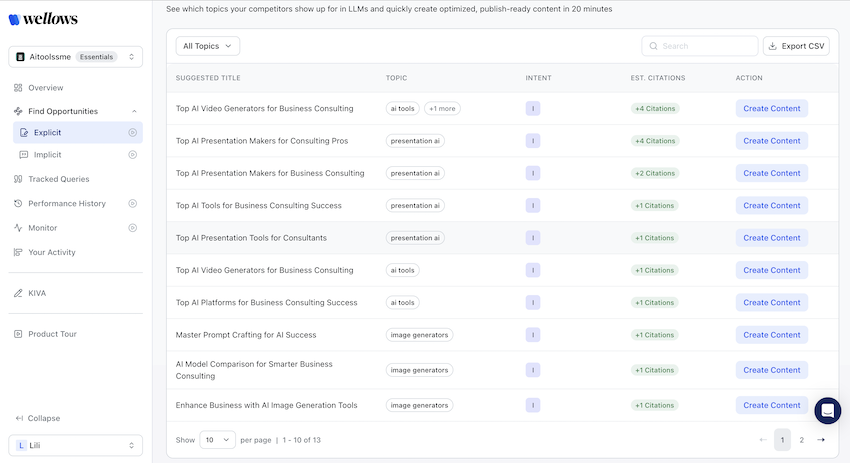
Wellows looks to me as if it was build with lovable, the simple dashboard makes it easy to get around and not get overwhelmed by too many features.
Let's start with it's weaknesses:
The suggested topics after scanning my website were not relevant to my business; they included keywords like Security, Performance, Customisation, Pricing Value, etc. These keywords can often be found on my website as they are part of the rating factors or from the tool comparisons, but by context, it could have understood that the overarching topic is AI tools. So I recommend to enter your own competitors and keywords to have a good base to work with. For the Explicit opportunities it seems to only give me topics involving consultants, not really my target audience. Implicit opportunities it can't find any.
The strenghts: I like the clarity of the dashboard, not overloading me with too much information like other tools. I also like the dashboard where you see a breakdown of all the LLM traffic coming to your page.

Passionfruit Labs is so much cheaper than all other GEO tools that I was rightfully suspicious. I'm still not sure if this is a lead generator actually for their consultation business, because the content Strategy feature is a bit weird: they suggest different gaps in content, but when you choose a topic to implement, they want to book an implementation meeting with you.
I think Passionfruit Labs is another product most likely built with Lovable and would require more experience for this specific topic.
I had to give Passionfruit Labs my domain and 4 competitors to get started and also tried to connect my Google analytics account but it didn't work.
Also all 10 topics they suggested are basically the same, only a word is changed in the suggested titles, but all are about ai tools for SMEs. I was looking for more variety, content too close to each other would cannibalise itself.
Prompt Analytics: I could only work with 5 predefined keywords I chose out of a list of about 20 in this feature, but they are not 100% what I’m looking for. A free search would make much more sense.
Basically all data I see within this platform is only based on 5 provided but irrelevant prompts.